
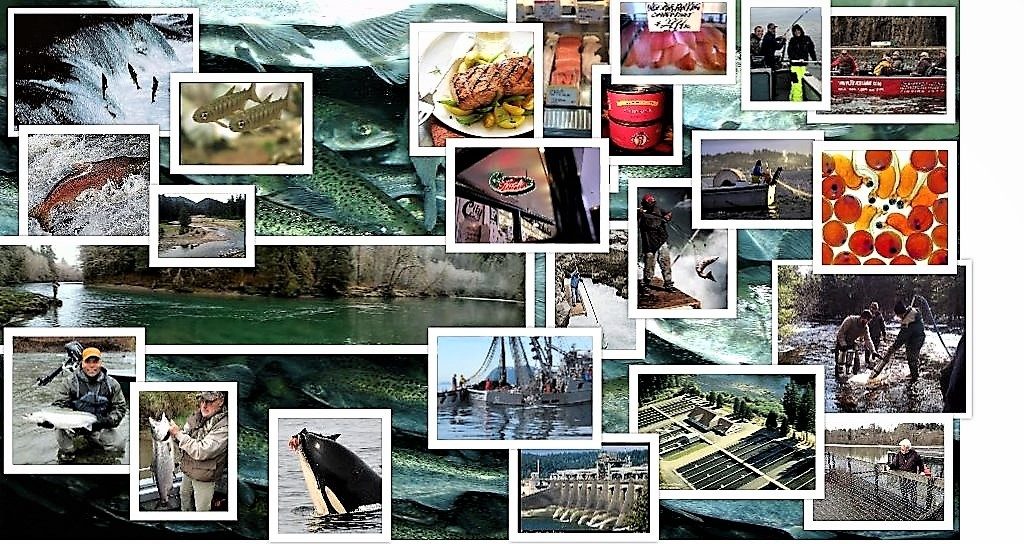
A VISION FOR THE COWLITZ RIVER FISHERY
Cowlitz River Advocacy- FERC Proceeding-*scroll down for proceedings
DRAFT — WORKING DOCUMENT,
What a healthy, well-managed Cowlitz looks like
This is a statement of what we are working toward — not a complaint, not a filing, and not a list of grievances. It is our answer to a simple question: what would a healthy, well-managed Cowlitz River fishery look like, for the people who fish it and the fish that return to it? The Cowlitz River can once again be one of the most productive fisheries in the Pacific Northwest, and a model for how hatchery and fisheries management should be done.
The return goals below were first developed several years ago in discussion with Friends of the Cowlitz. The numbers have held up. They remain the benchmark we believe a properly managed Cowlitz can and should meet.
Sustainable Adult Return Goals
Harvestable return goals for the mid-river, Barrier Dam, and up-river reaches of the Cowlitz (Tacoma’s responsibility). Each goal includes a natural-origin component where applicable and a trophy-class target reflecting a fishery managed for quality, not just volume.
| Run | Timing / Peak | Harvestable Target | Natural Origin Component- Harvestable | Trophy Component |
| Steelhead — Late Winter | Feb–Apr, peak March | 15,000 | 4,500 | 15% trophy, 15–25 lb |
| Steelhead — Summer | Jun–Aug, peak July | 25,000 | — | 15% trophy, 15–25 lb |
| Chinook — Spring (“Springer”) | Apr–Jun, peak May | 25,000 | 10,000 | 15% trophy, 20–35 lb |
| Chinook — Fall | Aug–Oct, peak mid-Sept | 25,000 | 12,000 | 15% trophy, 30–70 lb |
| Coho | Oct–Dec, peak late Oct/early Nov | 30,000 | 12,000 | 15% trophy, 15–30 lb |
| Sea-Run Cutthroat | Fall–Winter | 25,000 | — | 15% trophy, 3–5 lb |
| Rainbow Trout | Year-round, throughout river | 150,000 | — | — |
Active goals total: 145,000 harvestable adults river-wide.
A Run We Want Back
The early winter steelhead run no longer returns to the Cowlitz. It is not included in the active total above because it does not currently exist as a fishery to manage. But its restoration is a goal shared widely across the river community, and we list it here deliberately — as a marker of what was lost, and what we would like to see rebuilt:
| Run | Timing / Peak | Harvestable Target | Natural Origin Component | Trophy Component |
| Steelhead — Early Winter* | Nov–Feb, peak mid–late Dec | 15,000 (historic) | – | 15% trophy, 17–30 lb |
*Historic target shown for reference; this run is not currently returning to the river.
Understanding SARs — A Measuring Tool, Not the Goal
Smolt-to-Adult Return rates — SARs — are frequently discussed in Cowlitz hatchery management. It is important to understand what SARs are, and what they are not.
SARs are a measuring tool. They are not a target, and they are not the goal. The goal is adult returns — fish in the river, available for harvest and recovery.
A SAR is simply the percentage of smolts released from a hatchery that return as adults. If a hatchery releases 1,000,000 smolts and 10,000 adults return, the SAR is 1.0%. The SAR tells you how efficiently the program is converting smolt releases into adult returns.
The Northwest Power and Conservation Council (NPCC) has established a long-term SAR goal of 2–6% above Bonneville Dam for Columbia Basin salmon and steelhead populations. This range is the scientific benchmark for what a recovering population needs to sustain itself and support harvest. It is not an arbitrary number — it is derived from decades of Columbia Basin population modeling and represents the minimum threshold for avoiding continued decline.
SARs serve two distinct measurement purposes for the Cowlitz:
- They measure hatchery efficiency — whether the hatchery program is converting its smolt releases into the adult returns it is obligated to produce under the FERC license and Settlement Agreement.
- They measure natural-origin recovery success — whether natural-origin fish are returning at rates sufficient to sustain and grow the wild population, which is the long-term goal of both ESA recovery planning and the mitigation framework the Cowlitz hatcheries exist to support.
What SARs are not: a substitute for adult return goals. A program can report a SAR and still be failing to produce the adult returns the community was promised. The SAR tells you the rate. The adult return goal tells you the outcome. Both matter — but the outcome is what the community fishes for, what the tribes harvest, and what the wildlife agencies count when they evaluate whether a population is recovering.
The following table shows where the Cowlitz hatchery programs currently stand against the NPCC’s 2–6% SAR rebuilding target:
| Species | Cowlitz Return Data | NPCC Target | Status |
| Spring Chinook | 99.72% DNR (0.28% SAR) | 2–6% | Below replacement floor |
| Fall Chinook | 99.97% DNR (0.033% SAR) | 2–6% | Directed fishery eliminated |
| Coho | 98.45% DNR (1.55% SAR) | 2–6% | Below replacement floor |
| Late Winter Steelhead | 99.10% DNR (0.90% SAR) | 2–6% | Below replacement floor |
| Summer Steelhead | 99.14% DNR (0.86% SAR) | 2–6% | Below replacement floor |
Source: WDFW/Tacoma Power Annual Program Review data. Spring Chinook: 4-yr avg. Fall Chinook: most recent year. Coho: 3-yr avg. Late Winter and Summer Steelhead: 4-yr avg. NPCC target: Marmorek et al. 1998; McCann et al. 2018.
Every Cowlitz species is currently operating below the NPCC’s 2% replacement floor — the minimum threshold below which populations continue to decline. Spring Chinook, at 0.28%, are operating at less than one-eighth of the minimum needed for replacement. This is not a measurement debate. It is the central performance fact about the Cowlitz hatchery program.
SARs Equal Harvest Plus Escapement — Not Just Fish at the Hatchery
A critical point that is often lost in Cowlitz hatchery discussions: a SAR measures the total adult return — which means all adults that survived to return to the river, including both those harvested by anglers and tribes along the way and those that escaped past the fishery to reach the hatchery separator.
Getting fish back to the hatchery separator is not the goal. Getting fish back to the river — where they can be harvested, spawn naturally, and contribute to recovery — is the goal.
The formula is straightforward:
Total Adult Return = Harvest + Hatchery Separator Escapement + Natural Spawner Escapement
When a hatchery manager reports that spring Chinook are ‘returning to the hatchery,’ that tells you only what reached the separator. It tells you nothing about how many were harvested along the way — or how few. On the Cowlitz, the creel data for April through June 2026 shows 5% adult spring Chinook retention across 2,252 angler checks, while the separator was recording thousands of adults. A healthy hatchery fishery should produce substantial harvest before fish ever reach the separator. A fishery where almost no fish are caught on the way in is a fishery that is failing the community — regardless of what the separator count shows.
Harvest and Recovery — The Real Goals
The adult return goals in this document are harvestable return goals — not separator escapement goals. That distinction matters enormously. Here is what a properly managed Cowlitz fishery should produce from its adult returns:
| Category | Harvest Goal | Hatchery Escapement | Natural Spawner Goal | Recovery Purpose |
| Hatchery-Origin Returns (HOR) | 75–85% harvested | 15–25% to broodstock | Minimize — reduce pHOS | Harvest; sustain program |
| Natural-Origin Returns (NOR) | 25–40% harvested | N/A | 60–75% to natural spawning | Population recovery |
Note: Harvest percentages are illustrative targets consistent with mark-selective fishery practice and Washington state management standards. Specific rates by species and run should be established through the FTC’s directed decision process and reflected in approved HGMPs.
The hatchery separator is the endpoint for broodstock collection — it is where the program sustains itself. But it should not be the primary measure of program success. A program that gets 10,000 adults to the separator while anglers and tribes harvest almost nothing along the way is not producing what it is supposed to produce. It is producing broodstock. The community was not promised broodstock. It was promised a fishery.
For natural-origin fish, the goal is population recovery — measurable growth in self-sustaining wild populations that can eventually support harvest independent of the hatchery program. A healthy Cowlitz should be moving toward that goal, with each brood year showing natural-origin escapement above the level needed for replacement. That progress should be measured, documented, and reported — not buried in APR production discussions focused almost entirely on hatchery separator counts.
The Cowlitz hatchery program exists to produce a fishery and to recover wild fish. Getting fish back to the separator is the minimum — not the measure of success.
Improving SARs is necessary — but it is the means, not the end. The end is 145,000 harvestable adults returning to the Cowlitz River each year, with measurable progress toward wild fish recovery. Every management decision should be evaluated against that outcome.
The Goals Are Achievable — Not Aspirational
A common objection to any adult return goal is that it is unrealistic — that hitting these numbers would require producing far more fish than the Cowlitz can support. The numbers say otherwise.
In 2025, the Cowlitz hatchery programs released 6,975,767 smolts across Spring Chinook, Fall Chinook, Coho, Late Winter Steelhead, and Summer Steelhead combined. The combined harvestable adult return goal for those same five species in this document is 120,000 adults.
Reaching that goal requires a blended smolt-to-adult return rate of just 1.72% (120,000 ÷ 6,975,767) — a rate below the low end of the NPCC’s own 2–6% SAR rebuilding target, using smolts that are already being released each year. Reaching NPCC survival standards with the fish we already release would make the Cowlitz a benchmark for hatchery performance across the region.”
Put another way: if Cowlitz hatchery programs performed at the midpoint of the NPCC’s own standard — a 4% average SAR — the same 6,975,767 smolts released in 2025 would produce approximately 279,000 adults, more than double the combined adult return goal in this document.
This 1.72% figure is a blended average across five species with different current SARs (see table above); the improvement needed varies by species, and Spring Chinook in particular would require a larger relative gain than Coho. But the aggregate conclusion — that current release volumes already exceed what is needed to hit the combined adult return goal — holds regardless of how that improvement is distributed across species.
The adult return goals in this document are not aspirational. They ask for less than what the region’s own scientific standard says a properly performing hatchery program should produce from the fish already in the water.
Managed for the Whole River
A good Cowlitz fishery is not just a good hatchery outfall. Management and monitoring today are concentrated almost entirely around the point where hatchery-origin fish are released and recovered. We want to see a shift toward managing — and measuring success — for the whole river: the mainstem, the tributaries, and the reaches upstream and downstream of the hatchery complex alike.
A river managed only at the point of release is not a managed river. It is a managed outfall.
The scale of what is already happening on the Cowlitz demonstrates what the river can support: producing current wild coho returns of 10,000–14,000 adults has required transporting more than 30,000 adults above Cowlitz Falls Dam annually, collecting an estimated 150,000–200,000 or more outmigrating coho smolts each year. That is a scale of upstream passage and collection that is comparable to what spring Chinook and steelhead returning to Cowlitz Salmon Hatchery already require. The infrastructure, the biology, and the management capacity are there. The question is whether the will to manage for the whole river — and to measure success across all of it — is there as well.
Why This Document
Much of our work right now is about holding the current program accountable for what isn’t working. This document is the other half: a clear, positive statement of what we’re asking for instead. It is meant to be shared as our vision for the river — separate from, and not dependent on, any specific compliance or regulatory process.
The Cowlitz River was one of the most productive salmon and steelhead rivers on the Pacific Coast before the dams and after. The mitigation program was designed to replace what the dams took. It has not done that. This document describes what replacing it actually looks like, a river and fisheries management the Northwest looks to as the standard.”
Draft — Northwest Fisheries Enhancement Group | Larry Pryor, Chairman | lpryor@nwfe.org | 509-292-6410
Cowlitz River Advocacy- FERC Proceeding
I want to state plainly what this Complaint is, and is not, about. It is not a personal dispute with Tacoma Power or its staff. My goal, and the goal of the Northwest Fisheries Enhancement Group, Community members and Advocates is the genuine recovery of the Cowlitz River fishery — a resource that once supported, and could again support, meaningful recreational and economic activity for the communities along this river. A functioning fishery means fishermen, guides, tackle shops, fuel sales, lodging, and the everyday economic life of towns that have watched a public resource decline for years while being told, each year, that recovery is underway. I raise these compliance concerns because I believe the license’s fisheries provisions were written to prevent exactly this outcome, and because I believe DHAC’s review is capable of getting to the bottom of it. I respectfully hope, and ask, that DHAC undertake a complete and in-depth investigation of these matters, sufficient to determine, on the actual record and current data, whether that recovery is in fact occurring.


PUBLIC COMMENT ON THE GOVERNANCE AND FUNCTION
OF THE COWLITZ FISHERIES TECHNICAL COMMITTEE
Submitted by: Larry Pryor, Chairman
Northwest Fisheries Enhancement Group (NWFEG)
6 So 2nd Street, Suite 809, Yakima, WA 98901
lpryor@nwfe.org | 509-292-6410
To: Voting Members and Participants, Cowlitz Fisheries Technical Committee (FTC)
Re: Governance and Function of the FTC under Section 12 of the August 8, 2000 Cowlitz River Hydroelectric Project Settlement Agreement (“the Agreement”); Related to FERC Docket No. P-2016
I. Purpose of This Comment
This comment addresses the governance structure and the substantive duty of the Fisheries Technical Committee (“FTC”) under Section 12 of the Agreement. It is submitted for entry into the record of the FTC, separate from and in addition to the Supplemental FTC Complaint pending before the Federal Energy Regulatory Commission in Docket No. P-2016, which seeks structural reform of the FTC’s governance through Commission order. This comment asks the FTC’s own voting members to consider acting on authority the Agreement already gives them, independent of any future FERC ruling.
I want to be candid about why this comment is coming from a member of the public rather than from within the Committee itself. Raising governance gaps of this kind is not a role I sought out, and it is not one I believe should fall to a public participant rather than to the signatory agencies charged with this Committee’s oversight. I raise it because no one else has, and because the outcome I want is a straightforward one: a Cowlitz fishery that is recovering rather than declining, and an FTC that is functioning as the Agreement intended so that outcome is possible. This comment is offered in that spirit.
II. The FTC Belongs to All Signatories of the Agreement, Not to Any Single Party
Section 12.2 of the Agreement establishes the FTC’s membership as one representative each from Tacoma, NMFS, USFWS, WDFW, WDOE, and the Yakama Nation, and one joint representative from the Conservation Groups. The FTC is a body of co-equal signatory representatives — it was not created as, and does not function properly as, a committee owned or directed by any single Party.
Section 12.4 defines Tacoma’s role narrowly: Tacoma “shall be responsible for convening the FTC, including providing adequate notice to all FTC members and funding basic administrative services in support of the FTC’s efforts.” Nothing in Section 12.4 gives Tacoma — or any facilitator or contractor acting on Tacoma’s behalf — authority over the FTC’s substantive process, agenda content, or the scope of public participation.
Section 12.6 is explicit that rulemaking authority belongs to the FTC itself: “The FTC shall develop its own operating rules and procedures, emphasizing the importance of developing a consensus among FTC representatives on fishery measures.” The FTC has already exercised this authority once, adopting a formal Protocols for Public Participation document in 2022. That adopted protocol contains no restriction on referencing FERC filings in public comment. Any practice that functions as though a single Party controls the FTC’s process — including restricting the content of public comment beyond what the FTC’s own adopted protocols provide — is inconsistent with the governance structure the Agreement created.
III. Section 12.5 Imposes a Continuing Duty to Maximize Effectiveness — Not a Compliance Floor
Section 12.5 states that “the FTC shall be responsible for making recommendations on actions to maximize the effectiveness of fisheries mitigation, protection, and enhancement measures,” including, among other enumerated items, “such adaptive management recommendations as may be indicated by monitoring and evaluation measures.” Section 12.5 further requires that “recommendations of the FTC shall be in writing.”
This is a materially different standard from the numeric compliance thresholds found elsewhere in Appendix A — for example, the 95% Fish Passage Survival target in Article 1 or the 95% downstream fish passage survival rate in Article 2. Those are floor standards: a measure that meets the number is, on that metric, in compliance. Section 12.5’s “maximize” standard is not a floor. By definition, there is no point at which effectiveness is fully “maximized” and the duty is discharged — it is a continuing obligation to keep improving the effectiveness of mitigation, protection, and enhancement measures as monitoring data warrants, not a target to be met once.
A practical consequence follows: a measure can be technically compliant with a specific Article’s numeric threshold and still fall short of Section 12.5 if monitoring and evaluation data indicates further improvement is achievable and no written FTC recommendation has been made to pursue it.
IV. Documented Instances Where the Section 12.5 Duty Was Not Discharged
Tacoma’s own Article 8 Fish Disease Management Plan status reports and Article 415 acoustic-tag study together illustrate the gap between available monitoring data and any resulting written FTC recommendation.
The 2014 Article 415 acoustic tag study (Steig et al.) documented parasitized Mayfield Chinook smolts. That finding does not appear to have been cross-referenced by either the 2018 or the 2023 Article 8 disease report — two Tacoma-commissioned studies addressing the same reservoir and the same problem, filed under different license articles, years apart, without ever being connected into a documented adaptive management response. Tacoma’s 2023 Article 8 report shows C. shasta prevalence rising from 27.3% at Cowlitz Falls (upstream of Mayfield reservoir) to 56.8% at the Mayfield Counting House (downstream of the reservoir), alongside gill copepod prevalence of 78.6–100% at Mayfield versus effectively none at Cowlitz Falls, and mass Chinook mortality events in the Mayfield trap recurring across 2021, 2022, and 2023. This is precisely the kind of monitoring and evaluation data that Section 12.5 identifies as the trigger for a written adaptive management recommendation. No such written recommendation addressing the reservoir-specific pattern appears to have followed.
This is offered as a specific, documented example — not as an exhaustive account. It illustrates the pattern this comment asks the FTC to address: available data indicating decline, without a corresponding written recommendation under Section 12.5.
V. The FTC Has the Authority to Correct This Without Waiting for a Commission Order
Because Section 12.6 gives the FTC — not any single Party — authority to set its own operating rules, the FTC does not need to wait for FERC action to strengthen how it discharges its Section 12.5 duty. The FTC has already shown it can exercise this authority: its 2022 adoption of Protocols for Public Participation is a working precedent for FTC self-governance.
Accordingly, this comment respectfully requests that the FTC, under its Section 12.6 authority, consider formally adopting a written protocol providing that: (1) any Article 8, Article 415, or comparable monitoring or evaluation finding indicating a decline in mitigation, protection, or enhancement effectiveness be brought before the full FTC for review within a defined period; and (2) the FTC issue a written recommendation, consistent with Section 12.5’s requirement that FTC recommendations be in writing, addressing whether adaptive management action is warranted.
This request is made independent of, and without prejudice to, the structural relief sought in the pending Supplemental FTC Complaint before FERC in Docket No. P-2016. The FTC’s voting members — as the signatories jointly responsible for this Committee under Section 12 — are in the best position to correct this gap on their own initiative before it is imposed by external order.
VI. This Duty Has Consequences: Section 12.7 and the Agreement’s Broader Framework
Section 12.5 is not a standalone or symbolic provision. It sits inside a broader framework that gives written FTC recommendations real force, and that identifies adaptive management as one of the core mechanisms by which the entire Agreement is meant to function.
Section 12.7 provides that “for recommendations made directly to Tacoma, Tacoma shall follow the recommendations of the FTC unless it can establish good cause for rejecting or modifying such recommendations. Should Tacoma reject or modify such recommendations, it must notify the FTC in writing within 30 days of receiving the recommendations and state the reasons for rejecting or modifying such recommendations. If the dispute is not resolved, the positions of both the licensee and the FTC shall be provided as documentation of consultation in all FERC filings.”
This provision is what makes a written Section 12.5 recommendation consequential rather than advisory. Once the FTC issues a written recommendation, Tacoma is bound to follow it absent documented good cause, and any rejection must be disclosed in writing and carried into the public FERC record. The absence of written recommendations is therefore not merely a paperwork gap. It is the non-use of a mechanism that would otherwise require Tacoma to act, or require Tacoma’s refusal to act to become part of the public record before this Commission. An FTC that does not generate written recommendations under Section 12.5 is, in effect, declining to trigger the accountability mechanism that Section 12.7 was built to create.
This reading is reinforced by Section 6.1.2, which identifies “an adaptive management program to restore natural production” as one of the means by which “fisheries obligations will be met” under the Agreement as a whole — alongside effective upstream and downstream passage, habitat restoration, and continued artificial production. Adaptive management, and by extension the FTC’s Section 12.5 duty to generate written adaptive management recommendations, is not a peripheral FTC housekeeping function. It is one of the structural pillars the Agreement itself identifies as necessary to meet its fisheries obligations.
Section 6.1.1 further states that “the emphasis of this Agreement is ecosystem integrity and the restoration and recovery of wild, indigenous salmonid runs, including ESA-listed and unlisted stocks, to harvestable levels.” Section 6.1 identifies this and the other principles in Section 6.1 as guidance the Parties are to use in interpreting and implementing the Agreement where its plain language does not resolve a question. Read together with Section 12.5, this guidance supports interpreting the FTC’s “maximize the effectiveness” duty in light of the Agreement’s stated purpose: recovery to harvestable levels, not merely the avoidance of further decline.
Two further provisions are worth noting. Article 8 of Appendix A independently requires that the Disease Management Plan include “a review every five (5) years to see that the criteria for success are being met and a procedure and schedule for amending the plan if the criteria are not met.” This is a duty on Tacoma directly, separate from the FTC’s Section 12.5 duty, and raises the independent question of whether that five-year review process identified or addressed the Mayfield-versus-Cowlitz-Falls disease disparity described in Section IV above. Separately, Article 3(b)(iii) of Appendix A makes implementation of the Article 8 disease management plan one of three explicit criteria for triggering construction of volitional upstream fish passage facilities — meaning any gap in the disease management adaptive management response has potential consequences for one of the Agreement’s central fish passage milestones, not only for disease outcomes in isolation.
Finally, Section 12.3 requires that “draft plans, reports and recommendations developed by the FTC shall be provided to all Parties for review and comment,” and that “Parties will also be provided with final products of the FTC.” Whether this circulation requirement has been consistently met is a separate, factual question worth confirming, as it bears directly on whether the FTC’s process is functioning as the Agreement requires even apart from the substantive gap described above.
VII. Confirming FTC Representative Qualifications Under Section 12.2
Section 12.2 sets differentiated qualification standards for each category of FTC seat: “Agency representatives will be aquatic scientists. The representatives of the Yakama Nation and the Conservation Groups will be either aquatic scientists or persons with extensive knowledge of the Cowlitz River basin.” These are not general aspirations — they are specific, textual membership requirements for a committee the Agreement designed to be substantive and expert, not a rubber stamp.
This comment respectfully requests that each Party confirm, for the FTC’s record, the qualifying basis for its current representative: aquatic science credentials for Agency representatives, and aquatic science credentials or documented extensive knowledge of the Cowlitz River basin for the Yakama Nation and Conservation Group representatives. I note that Section 12.2’s “Agency representatives” requirement applies, by the Agreement’s own definition of “the Agencies” in Section 1.2, to WDFW, WDOE, USFWS, and NMFS. Tacoma is defined separately as “the Licensee,” and I am not aware of an explicit qualification standard in Section 12.2 that applies to Tacoma’s own FTC representative. If that reading is correct, it is worth the Parties’ attention as a gap in the Agreement’s text, separate from the question of any individual representative’s qualifications.
I raise this as a confirmation request, not as an assertion that any current representative fails to meet these standards. I do note, however, that the “extensive knowledge of the Cowlitz River basin” standard set for the Yakama Nation and Conservation Group seats is a standard that members of the public who regularly attend FTC meetings, including myself, plainly meet — and the Agreement places no limit on Conservation Group or Yakama Nation representation confining it to any particular individual for the life of the license.
VIII. Conclusion
The FTC was created by all signatories to the Agreement to maximize the effectiveness of the Cowlitz Project’s fisheries mitigation, protection, and enhancement measures — not to serve as a forum controlled by any one Party. I respectfully ask the voting members to take up this comment, consider the documented gap described above, and consider exercising the FTC’s own Section 12.6 authority to close it. My hope in raising this is simple: a fishery that improves rather than declines, and an FTC equipped and willing to do the job the Agreement gives it.
Respectfully submitted,
Larry Pryor
a concerned Cowlitz River fisheries advocate and Chairman, Northwest Fisheries Enhancement Group (NWFEG)
A Closing Note
Beyond the qualification question above, I’d offer one further observation — as my own perspective, not as a claim of non-compliance. The Agreement’s design assumes FTC representatives bring not only technical qualification but genuine engagement with Cowlitz fisheries outcomes. In my years participating in this process, it has often seemed to me that this body’s members are professionally and contractually connected to the Cowlitz fishery, but not personally vested in its recovery the way an angler, guide, or basin resident is. I raise this not as a criticism of any individual, but as a possible explanation for why a technically-constituted committee has, in my view, struggled to produce the adaptive management outcomes Section 12.5 anticipates.

